
How to Search Long County Court Records
Long County does not publish one county-run portal that covers every Superior, State, Magistrate, Probate, Juvenile, and municipal case. Start with the court level. Superior Court handles felonies, divorce, land, equity, and broad civil cases. State Court handles misdemeanors, traffic, and some civil matters. Probate Court handles estates, marriage licenses, guardianships, conservatorships, weapons carry matters, and vital-record functions. Magistrate Court handles small claims, dispossessory cases, garnishments, warrant applications, county ordinance matters, and bail setting. Juvenile Court records are held by the clerk but are restricted.
The Clerk of Superior Court is the first local contact for Superior, State, and Juvenile Court records. Online access may be available through Georgia Courts e-access or PeachCourt, but provider accounts and document fees may apply. State Court traffic and court payments use the Long County State nCourt/Catalis path, while Ludowici city traffic payments can route through Government Window. Probate and Magistrate records are usually handled through the local Probate/Magistrate office and its published forms and fee pages.
- Identify the record type, such as felony, misdemeanor, divorce, traffic, probate, small claim, inmate, or warrant.
- Use the Clerk of Superior Court for Superior, State, and Juvenile files, with party names, year, case type, and case number if known.
- Check Georgia Courts e-access or PeachCourt when online document access is available for the court and case type.
- Use the State Court payment portal or Ludowici Government Window only for the traffic or payable citation lane that matches the ticket.
- Call Probate/Magistrate Court or the Sheriff's Office when the record is a probate, marriage, small-claim, warrant, jail, or agency record.
The Long County Board of Commissioners site is the main county web entry point for local government. The screenshot below reflects the county-level source used to orient local office and history details.
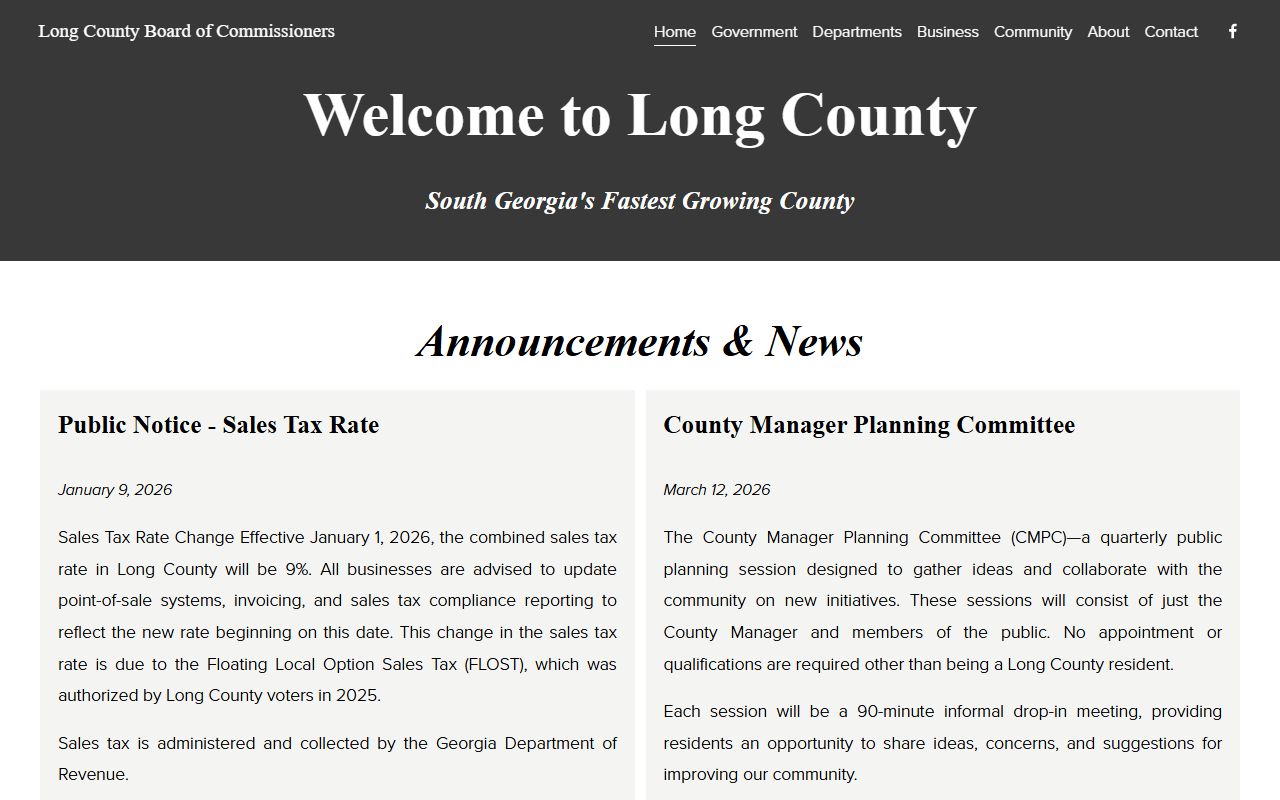
That county source is useful context, but court users still need the court-specific offices and state systems listed below.
Long County Courthouse Offices
The primary court address for Superior and State Court users is 49 South McDonald Street in Ludowici. The GSCCCA clerk directory lists the Clerk of Superior Court at 458 South McDonald Street and P.O. Box 458, which should be treated as the clerk's published office and mailing address. The research supports describing this as a local courthouse and office addressing issue rather than choosing one address and ignoring the other.
Probate and Magistrate Court use a different local office path. The Probate Court page lists P.O. Box 426 and 447 S. McDonald Street, while the Georgia Department of Public Health vital-record location page lists the Probate Court vital-record location at 75 W Academy Street. Call before visiting when the task involves vital records, forms, or a filing deadline.
Superior and State Court
49 South McDonald Street
Ludowici, GA 31316
(912) 545-2123
Clerk of Superior Court
458 South McDonald Street / P.O. Box 458
Ludowici, GA 31316
(912) 545-2123
Monday-Thursday 8:00 a.m.-5:00 p.m.; Friday 8:00 a.m.-4:40 p.m.; lunch closure 12:00 p.m.-1:00 p.m.
Probate and Magistrate Court
447 S. McDonald St. / P.O. Box 426
Ludowici, GA 31316
(912) 545-2131
Long County Court System
Georgia does not use "District Court" as Long County's main county-level trial court name. The primary trial court is Superior Court, and Long County Superior Court is part of the Atlantic Judicial Circuit. The same circuit serves Bryan, Evans, Liberty, McIntosh, and Tattnall counties. Appeals generally move to the Court of Appeals of Georgia unless Supreme Court jurisdiction applies.
Long County also has State Court, Juvenile Court, Probate Court, Magistrate Court, and municipal/city traffic channels. State Court meets on the second and fourth Wednesday at 9:00 a.m. unless notice says otherwise. Probate Judge Teresa L. Odum also serves as Chief Magistrate Judge on the local Probate/Magistrate site.
Case flow: Magistrate, Probate, State, or Superior Court › Court of Appeals of Georgia or Supreme Court of Georgia › final appellate action.
| Court | Long County role | Common records |
|---|---|---|
| Superior Court | General jurisdiction trial court in the Atlantic Judicial Circuit | Felonies, divorce, equity, land title, broad civil cases |
| State Court | Limited trial court for misdemeanors, traffic, and civil cases not exclusive to Superior Court | Citations, misdemeanor cases, traffic dispositions, fines |
| Probate Court | Local probate, marriage, guardianship, conservatorship, weapons carry, and vital-record functions | Estates, wills, marriage licenses, guardianship orders |
| Magistrate Court | Small claims, dispossessories, garnishments, warrant applications, and bail setting | Claims, dispossessory filings, warrant applications, fee records |
| Juvenile Court | Child-related delinquency, dependency, and related matters | Restricted juvenile files |
Long County Court Record Types
Long County court records vary by court. Civil files can include complaints, answers, counterclaims, motions, notices, orders, judgments, garnishments, liens, FiFa filings, and dispossessory actions. Criminal Superior Court records can include warrants, indictments, accusations, bond orders, arraignment entries, motions, plea paperwork, trial entries, sentencing, probation terms, and final disposition.
State Court misdemeanor and traffic records may include citations, accusations, pleas, fine and cost assessments, proof-of-correction notes, continuances, dispositions, and failure-to-appear actions. Probate records cover wills, estates, year's support, inventories, bonds, accountings, and orders. Marriage records come from Probate Court, while divorce files are Superior Court case records.
- Criminal court records: the court case file, not just a booking or charge row.
- Civil court records: pleadings, orders, judgments, liens, garnishments, and dispossessory matters.
- Family and divorce records: Superior Court files that may include decrees, settlement terms, and modification filings.
- Probate records: estate, guardianship, conservatorship, marriage, and vital-record related files.
- Traffic records: State Court or Ludowici citation files, separate from a DDS driving history.
What Long County Court Records Show
A Long County court record may show a case number, court, party names, filing date, charge or claim, hearing entries, orders, judgment, sentence, fine, bond, or disposition. In criminal and inmate-related records, the same person can have a booking entry, a warrant number, formal charges, and a later criminal case disposition. Those records are connected, but they are not the same file.
| Field | What it means locally |
|---|---|
| Case number | Assigned by the court, clerk, or provider; warrant rows may show year-coded warrant numbers. |
| Court | Superior, State, Probate, Magistrate, Juvenile, or municipal/city court. |
| Parties | Plaintiff and defendant, State and defendant, petitioner and respondent, or estate parties. |
| Charge or claim | Criminal statute, traffic offense, civil cause, probate petition, or magistrate claim. |
| Status or disposition | Open, closed, dismissed, disposed, sealed, restricted, currently booked, or bond denied. |
| Financial fields | Filing fees, service fees, fines, restitution, bond, copy fees, or provider charges. |
Long County Court Public Access
Georgia law favors public access to public records, but Long County records still have court-rule limits, sealing rules, juvenile restrictions, and redaction duties. Case files are usually requested from the clerk or court that maintains the file. Agency records, such as sheriff incident, jail, or warrant-processing records that are not online, can be requested through the records custodian under Georgia's Open Records Act.
The Georgia open records overview explains the public-records request process at the state level. Court users should also account for redaction rules and confidentiality limits before assuming a file is fully public.
Key statutes:
O.C.G.A. § 50-18-70 states Georgia's policy favoring access to public records unless an exemption applies.
O.C.G.A. § 50-18-71 covers inspection, copying, timing, and fee rules for public records.
O.C.G.A. § 9-11-7.1 requires protected data to be redacted from certain civil filings.
O.C.G.A. § 15-11-701 controls juvenile file sealing and access restrictions.
The Georgia exemptions statute also matters when a request includes sensitive law-enforcement, juvenile, personal, or sealed material.
The Georgia open records screenshot below is from the official Governor's Office access page.
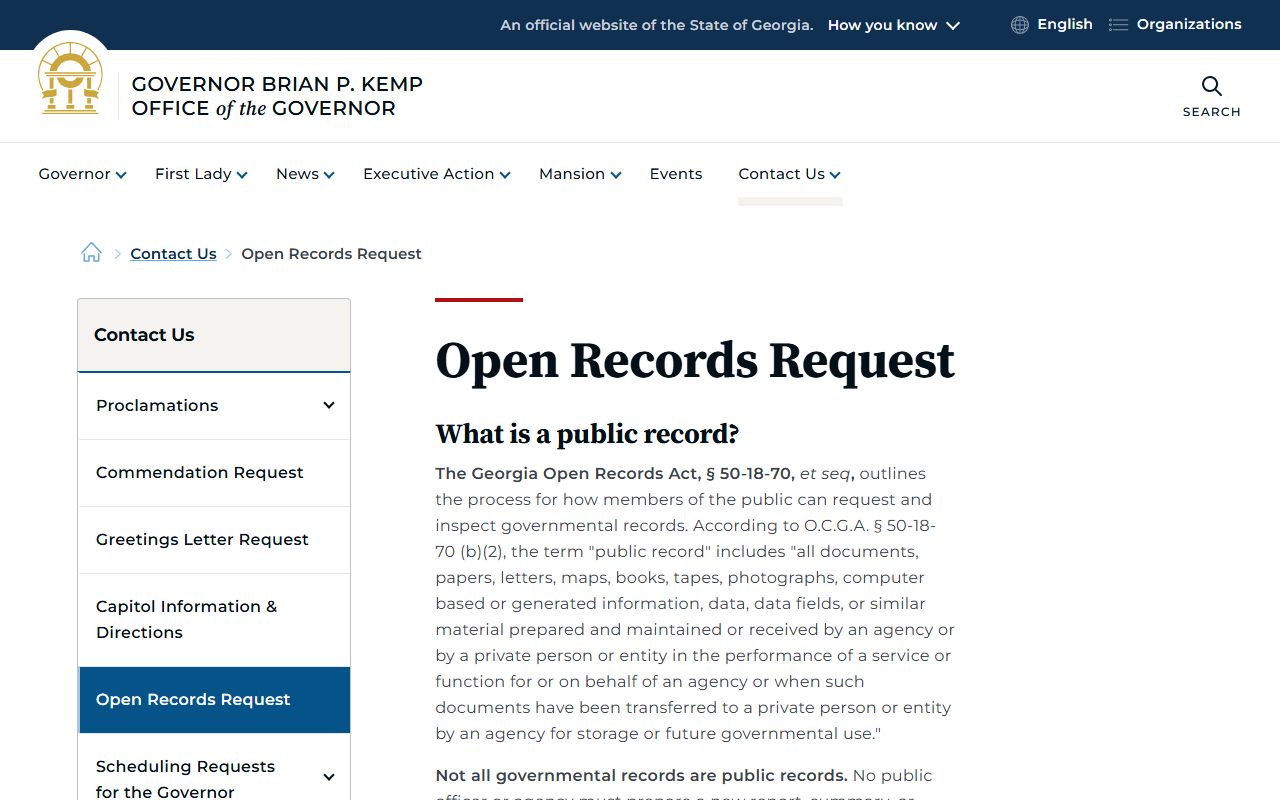
Use open-records requests for agency records and administrative records, while case files usually remain with the court clerk or issuing court.
Restricted Long County Court Records
Juvenile records are not ordinary adult public files. Georgia law separates juvenile files from adult arrest files and allows sealing. Access is usually limited to parties, attorneys, court staff, prosecutors, law enforcement in authorized circumstances, or people with a court order.
Criminal-history restriction is also different from deleting a court case. Qualifying dispositions under Georgia law can restrict public access to criminal history record information, and some first-offender court records can become unavailable to the public. Adoption records, mental-health matters, sealed warrants, and protected personal identifiers should not be treated as standard public search results.
Note: A clerk can confirm whether a public copy exists, but case-specific access to sealed material may require a court order.
Long County Sheriff and Jail Records
The Long County Sheriff's Office is led by Sheriff Craig Nobles and operates from 6 East Academy Street in Ludowici. The office publishes links for current inmates, warrants, sex offenders, contact, crime tips, citation payment, and related services. For emergency help use 911; for non-emergency sheriff business use (912) 545-2118.
The key jail fact is local and important: Long County does not currently operate its own jail. The Sheriff's Office says the old courthouse jail was not restored after a fire in the early 1980s, so Long County inmates are housed in surrounding county jails. The official current-inmate roster may show housing in counties such as Appling, McIntosh, Tattnall, Pierce, or other facilities. The full custody workflow belongs on the Long County inmate records page, while active warrant options belong on the Long County warrant records page.
Long County Traffic Court Records
Long County State Court handles traffic cases and misdemeanors. The State Court page names Judge Jeffrey L. Arnold, Clerk Sherry Long, and Solicitor General Brooklyn Franklin. It also states that State Court is held on the second and fourth Wednesday at 9:00 a.m. unless otherwise notified. Court-date notices come from the Clerk's Office, and address changes are the person's responsibility.
Traffic payments may use the Long County State nCourt/Catalis portal, phone support at (877) 685-4495, or court contact through the clerk. City-issued Ludowici tickets may route through Government Window, which is separate from the county State Court payment path. DDS driving histories are separate state driver records, not the same as a court citation file.
| Channel | Use it for | Identifier |
|---|---|---|
| Long County State nCourt/Catalis | County State Court ticket or court payment | Citation number or court payment information |
| Ludowici Government Window | City traffic ticket, property tax, or utility payment category | Traffic ticket selection and city payment path |
| Georgia DDS MVR | Driver history, points, license status, suspension, or revocation | Driver identity information through DDS |
Long County Marriage Divorce Probate
Marriage licenses are issued by Long County Probate Court. The local page lists an $80 marriage license fee, reduced to $40 with a qualifying premarital education certificate. Applicants must bring accepted identification, and previously married applicants need a final divorce decree or death certificate. Georgia no longer requires a blood test.
Divorce records are Superior Court records, not Probate Court files. Certified divorce decree copies come from the Clerk of Superior Court. Georgia DPH can provide limited divorce verifications for divorces from June 1952 through August 1996, but those verifications are not the full decree or case file.
- Testator
- The person who made a will.
- Executor
- The person appointed to carry out a will after death.
- Conservator
- A person appointed to manage property or finances for someone who cannot do so alone.
Long County Court Records Fees
Fee details depend on the court and record. PeachCourt lists document purchases at $0.50 per page plus a convenience fee where participating court documents are available. Long County Magistrate Court publishes several local filing and service amounts. Probate Court publishes marriage license fees. The research did not locate a complete Long County certified-copy fee schedule for every court record type, so copy-cost questions should be confirmed with the clerk before mailing payment.
| Item | Amount | Source note |
|---|---|---|
| PeachCourt document purchase | $0.50 per page plus convenience fee | Provider document FAQ where available |
| Magistrate statement of claim | $105.00 | Includes one service |
| Magistrate dispossessory affidavit | $80.00 | Includes one service |
| Criminal warrant application | $20.00 | Local Magistrate fee |
| Sheriff's service or re-service | $50.00 | Local price list |
| Marriage license | $80.00, or $40.00 with qualifying premarital education | Probate Court marriage page |
Reading Long County Court Records
A docket is the chronological list of filings and events in a case. A disposition is the way a case or charge ended. A bond is the money, property, or surety promise tied to release. A warrant is a judge-authorized command for arrest or search. A FiFa is a writ used to record or enforce a judgment. These terms can appear in Long County court or sheriff records, but they do not always mean the case is over.
Charge records need special care. A charge is an accusation or formal count. A conviction is an outcome after a plea, verdict, or other disposition that counts as guilt. A dismissed, nolle prosequi, restricted, sealed, or first-offender matter can look different in a court file, criminal history, and jail roster.
Long County Court History
Long County was created from Liberty County in 1920 and named for Dr. Crawford W. Long. Ludowici is the county seat. The courthouse was built in 1926 and is tied to the county's early need for a closer seat of government for western Liberty County residents.
The official Long County history page gives local background on the county's creation and name.
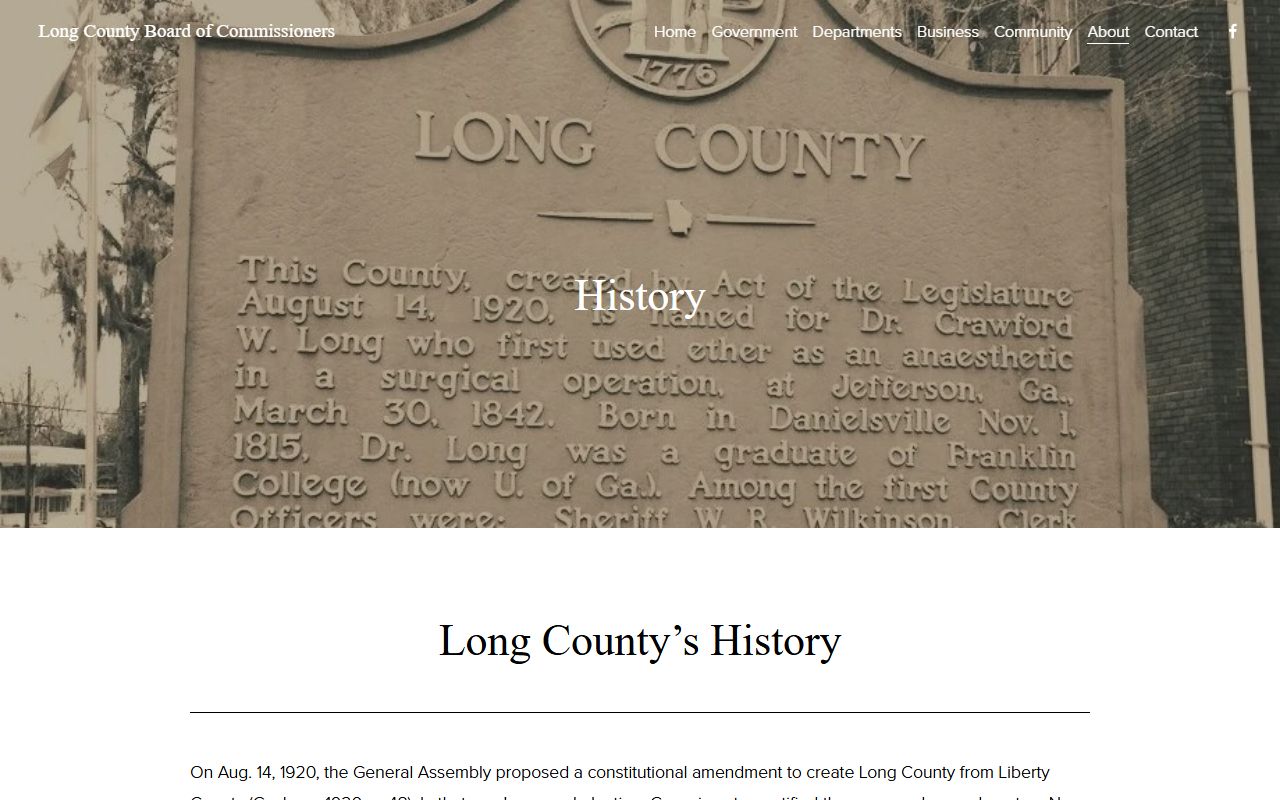
That history still affects court access because Long County operates as a small rural court system where many practical answers come from the clerk, sheriff, or Probate/Magistrate counter.
Long County Court Records FAQ
Where do I start a Long County court records search?
Start with the court type. Superior, State, and Juvenile Court records route through the Clerk of Superior Court. Probate and marriage records route through Probate Court. Small claims and warrant applications route through Magistrate Court. Jail and warrant-processing records route through the Sheriff's Office.
Are all Long County court records online?
No. Georgia Courts e-access and PeachCourt may provide provider-based access for some records, but Long County does not have one free county portal for every case file. Older records, certified copies, sealed matters, and court-specific questions often require clerk contact.
Who handles Long County traffic tickets?
County traffic cases usually route through Long County State Court, while city citations may route through Ludowici Government Window. The citation should identify the issuing court. DDS driver records are separate from the court's traffic file.
Does Long County have its own jail roster?
The Sheriff's Office links to an official current-inmate roster, but Long County does not operate its own jail. Roster entries may show inmates housed in surrounding county jails.
Where are Long County divorce records kept?
Divorce is a Superior Court matter. Certified decree copies should be requested from the Clerk of Superior Court, while DPH divorce verifications are limited and are not full decrees.
Can staff tell me which form to file?
Probate/Magistrate staff can explain general court process, forms, deadlines, and file information. They cannot give legal advice, predict outcomes, phrase answers, contact the judge for a party, or change an order.